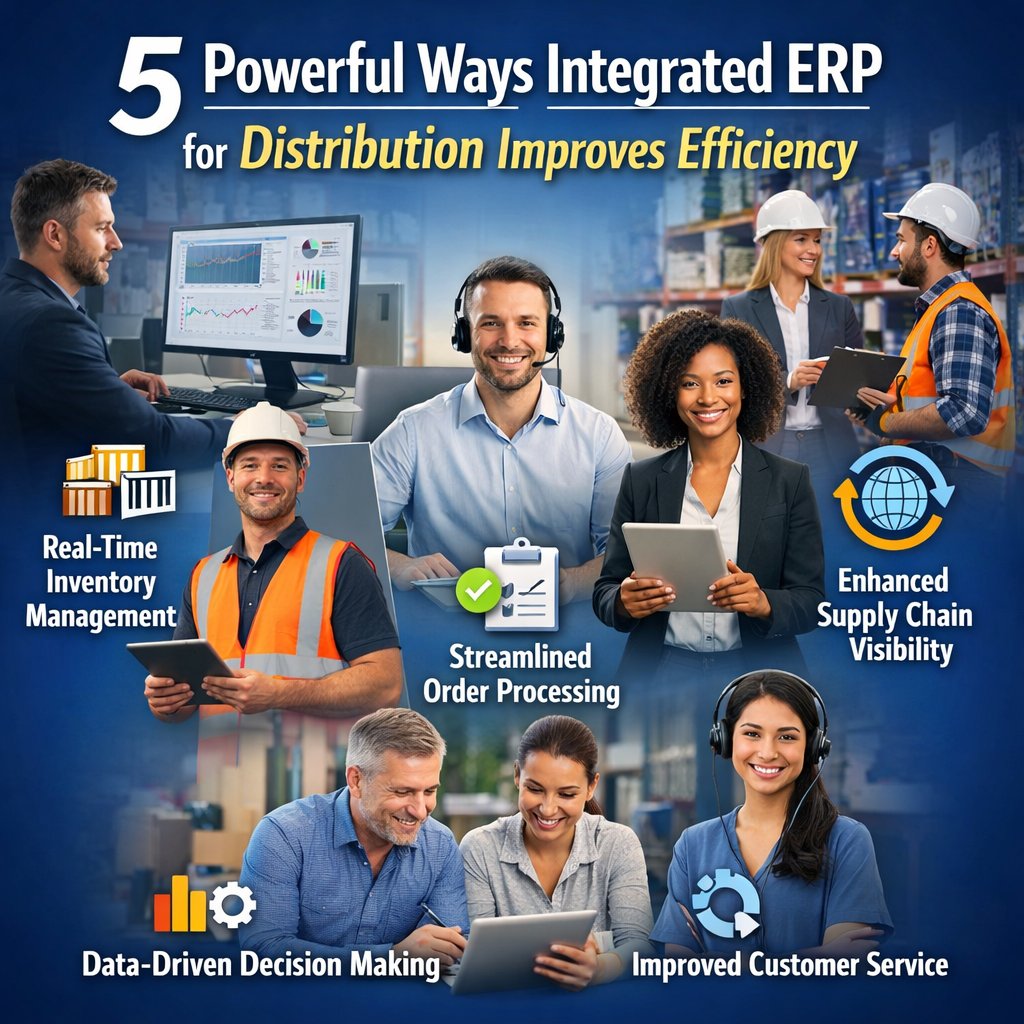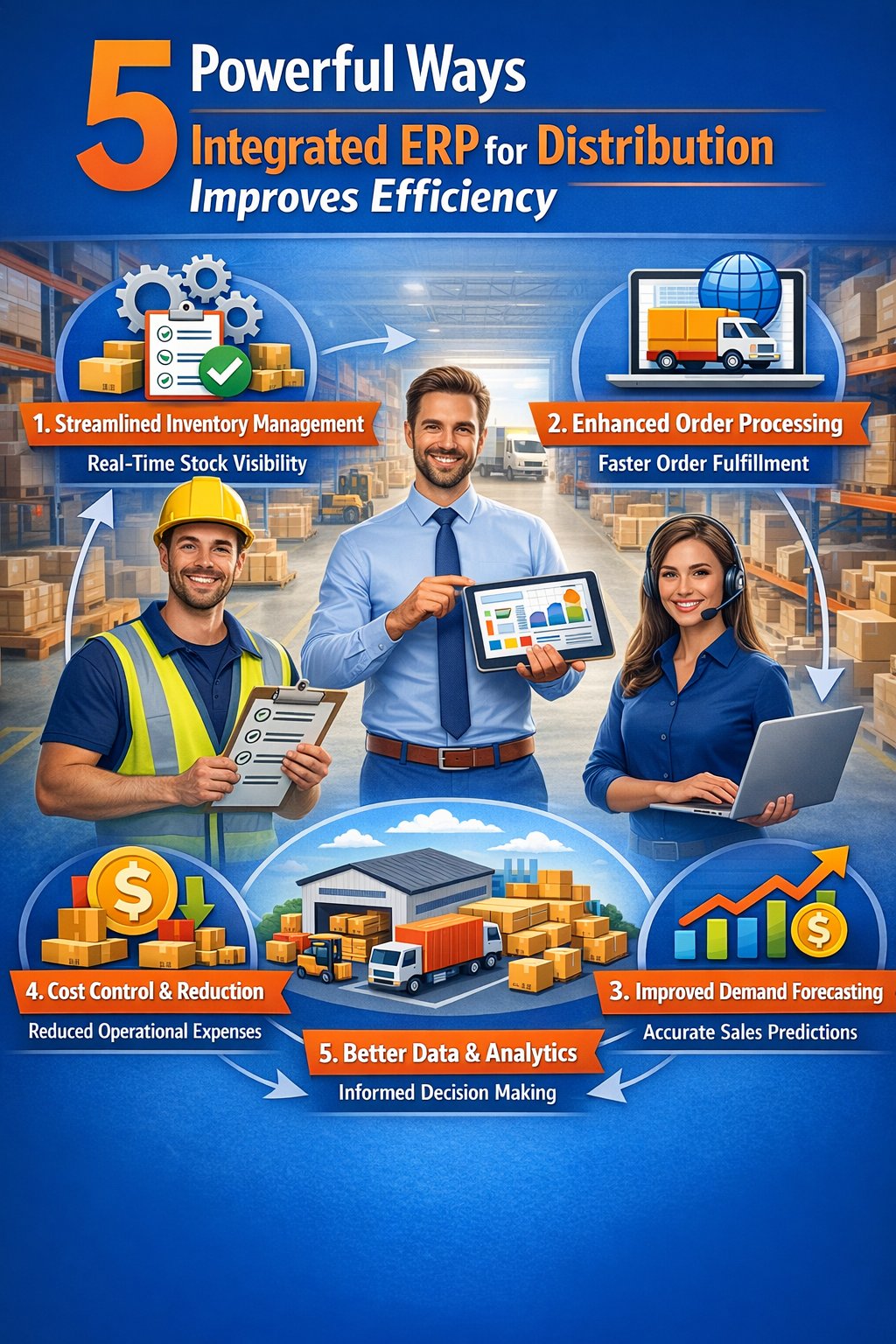
5 Powerful Ways Integrated ERP for Distribution Improves Efficiency
Integrated ERP for Distribution plays a crucial role in helping distribution companies streamline operations, improve inventory management, and enhance overall supply chain efficiency. As businesses grow and distribution networks become more complex, relying on disconnected systems can lead to delays, errors, and limited visibility across operations. By implementing an integrated ERP solution, organizations can centralize their processes, automate workflows, and gain real-time insights that support faster and more accurate decision-making.
Many companies are adopting Integrated ERP for Distribution to gain real-time visibility into their supply chain and improve coordination between warehouses, sales teams, and logistics operations.
How Integrated ERP for Distribution Improves Warehouse and Supply Chain Efficiency
With Integrated ERP for Distribution, businesses can automate order processing, track inventory across multiple locations, and optimize distribution workflows.
Business Challenge
The client, a growing distribution company, was experiencing several operational challenges due to fragmented systems and manual processes. Their existing setup relied on multiple software tools that did not communicate with each other, making it difficult to track orders, manage inventory, and coordinate logistics effectively.
Some of the key challenges included:
-
Lack of Real-Time Inventory Visibility – The company struggled to monitor stock levels accurately across multiple warehouses.
-
Manual Order Processing – Sales orders were handled manually, leading to delays and errors in order fulfillment.
-
Inefficient Warehouse Operations – Without a centralized system, warehouse teams found it difficult to manage inventory movement and optimize storage.
-
Limited Reporting and Insights – Decision-makers lacked real-time data and reports to support operational improvements.
These issues were affecting the company’s ability to scale operations and maintain high service levels for customers.
How Integrated ERP for Distribution Improves Operational Efficiency
To address these challenges, the organization implemented an integrated ERP system designed to unify its core business processes. The ERP platform enabled seamless integration between inventory management, sales, procurement, and accounting functions.
The implementation focused on creating a centralized system that would provide real-time visibility into all distribution activities.
Key components of the ERP solution included:
Inventory Management
The ERP system provided real-time tracking of stock levels across multiple locations, enabling the company to maintain optimal inventory levels and reduce stockouts.
Order Management Automation
Sales orders could now be processed automatically within the system, significantly reducing manual errors and improving order fulfillment speed.
Warehouse Management Optimization
The integrated ERP platform streamlined warehouse operations by improving product tracking, inventory movement, and storage organization.
Advanced Reporting and Analytics
The new system generated real-time reports and dashboards that helped management monitor performance, identify bottlenecks, and make data-driven decisions.
Implementation Process
The ERP implementation followed a structured approach to ensure minimal disruption to the company’s ongoing operations.
-
Business Process Analysis – The team evaluated existing workflows to identify inefficiencies and improvement opportunities.
-
System Configuration and Customization – The ERP platform was configured to align with the company’s distribution processes.
-
Data Migration and Integration – Existing operational data was migrated into the new system, ensuring continuity and accuracy.
-
Training and Deployment – Employees received training to help them adapt to the new system, and the ERP solution was deployed in phases.
This phased approach helped ensure a smooth transition and improved user adoption across departments.
Results and Business Impact
The implementation of Integrated ERP for Distribution allowed the company to reduce manual errors and significantly improve order fulfillment speed. Following the ERP implementation, the company experienced significant improvements in operational efficiency and distribution performance.
Key results included:
-
Improved Inventory Accuracy – Real-time inventory tracking reduced stock discrepancies and improved warehouse visibility.
-
Faster Order Processing – Automated workflows significantly reduced order processing time.
-
Enhanced Distribution Efficiency – Streamlined warehouse operations improved product movement and order fulfillment.
-
Better Decision-Making – Real-time analytics and reporting enabled management to monitor operations and optimize performance.
Overall, the integrated ERP solution helped the company create a more efficient and scalable distribution operation.
Conclusion
For distribution-driven organizations, operational efficiency and real-time visibility are critical for success. By implementing an integrated ERP system, the company was able to transform its distribution processes, improve accuracy, and enhance overall productivity.
This case study demonstrates how the right ERP solution can help businesses overcome operational challenges, streamline workflows, and build a stronger foundation for future growth. By leveraging Integrated ERP for Distribution, companies can streamline distribution operations, enhance inventory accuracy, and build a more scalable supply chain.
Planning an ERP implementation for your business?
KoderClub Technologies helps organizations design and implement scalable ERP solutions tailored to their operational needs.