

Introduction
Enterprise Resource Planning (ERP) systems play a critical role in helping businesses integrate operations, improve efficiency, and gain real-time insights across departments. However, despite the benefits, many ERP implementations fail to deliver expected results due to poor planning, unrealistic expectations, or lack of proper execution strategy. Understanding and avoiding common ERP implementation mistakes can significantly enhance the chances of success. By being aware of the common pitfalls, organizations can navigate their projects more effectively.
ERP projects are complex transformations that affect multiple departments, workflows, and data structures. Without the right approach, organizations can experience delays, budget overruns, and low user adoption.
Recognizing these ERP implementation mistakes early in the process can save time and resources, ensuring that businesses achieve their operational goals and avoid common ERP implementation mistakes.
Addressing these issues early can lead to a smoother process and a more successful outcome. It is crucial for teams to document and review all potential ERP implementation mistakes.
Understanding common ERP implementation mistakes can help businesses avoid costly setbacks and ensure a successful transition to a modern integrated system. It is crucial to address these ERP implementation mistakes to facilitate a smoother changeover and improve overall efficiency.
1. Lack of Clear Business Objectives
Avoiding ERP Implementation Mistakes for Successful Outcomes
One of the most common ERP mistakes is starting the implementation without clearly defined business goals. Companies sometimes adopt ERP systems simply because competitors are doing so or because their existing software is outdated.
Without clear objectives, ERP implementation can lose direction and fail to deliver measurable business value.
Organizations should first define what they want to achieve with ERP — whether it is improved inventory control, automated workflows, better reporting, or enhanced operational visibility.
2. Insufficient Requirement Analysis
ERP systems impact nearly every department within an organization. If requirements are not properly documented during the planning phase, the system may fail to address key operational needs.
Detailed requirement analysis should involve stakeholders from multiple departments such as finance, operations, sales, and procurement. This ensures the ERP solution reflects real business workflows.
Proper requirement gathering also helps avoid excessive customization later in the project.
3. Choosing Technology Before Understanding Processes
Many businesses focus on selecting ERP software before analyzing their internal processes. This often leads to implementing technology that does not align with the organization’s workflow.
A better approach is to first evaluate existing processes, identify inefficiencies, and redesign workflows where necessary. Once the operational structure is clear, ERP modules can be selected accordingly.
4. Underestimating Change Management
ERP implementation introduces significant changes to how employees work. If teams are not properly trained or involved in the transition, resistance to change can slow down adoption.
Successful ERP projects include strong change management strategies such as user training, communication sessions, and gradual system rollout.
When employees understand the benefits of the new system, adoption becomes much smoother.
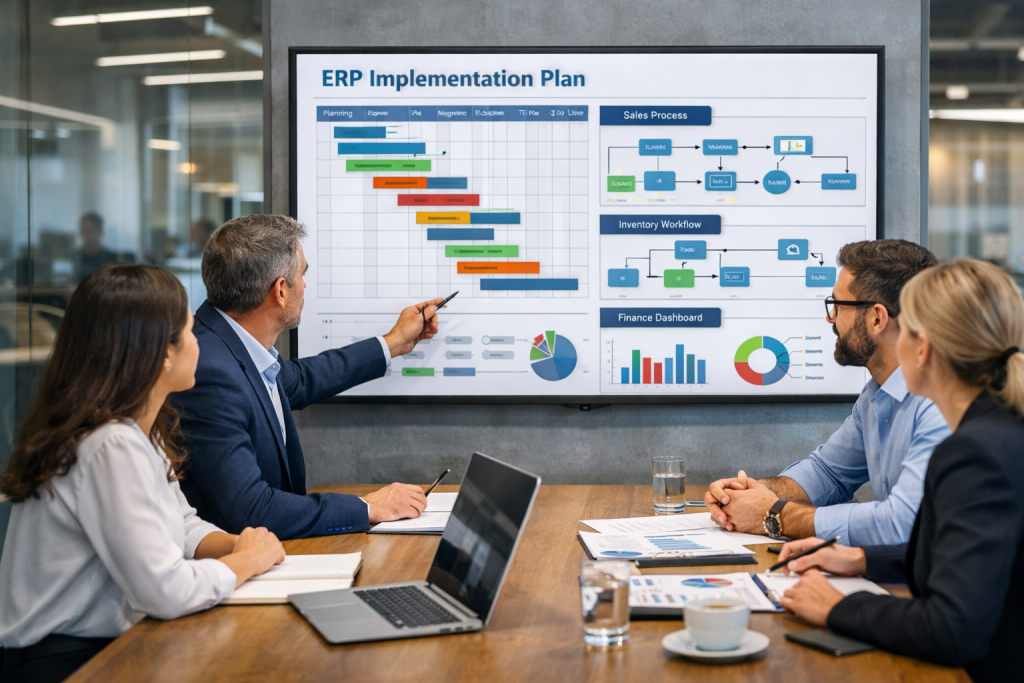
Odoo ERP implementation,
ERP project challenges,
ERP consulting,
ERP implementation strategy
5. Poor Data Migration Planning
Data migration is one of the most sensitive phases of an ERP implementation. Incomplete or inaccurate data can disrupt operations and create reporting errors.
Organizations should audit existing data, clean redundant records, and validate information before migration.
A structured data migration plan ensures that the ERP system starts with accurate and reliable information.
6. Lack of Experienced Implementation Partner
ERP implementation requires both technical expertise and business understanding. Attempting to deploy ERP systems without experienced consultants can increase risks significantly.
Working with an experienced implementation partner ensures proper planning, configuration, customization, and post-go-live support.
Experienced ERP consultants help organizations avoid common pitfalls and accelerate implementation success.
7. Ignoring Post-Implementation Support
Many organizations focus heavily on implementation but neglect ongoing support and optimization.
ERP systems evolve as businesses grow, and continuous improvements are necessary to maintain efficiency.
Post-implementation support includes system monitoring, performance optimization, feature enhancements, and periodic system reviews.
Conclusion
ERP implementation can transform business operations when executed with the right strategy and expertise. However, avoiding common mistakes is essential to ensure the system delivers long-term value.
By focusing on clear objectives, structured planning, proper training, and expert guidance, businesses can successfully implement ERP systems that streamline operations and support future growth.
Organizations considering ERP adoption should approach the project as a strategic transformation rather than just a software deployment.
Planning an ERP implementation for your business?
KoderClub Technologies helps organizations design and implement scalable ERP solutions tailored to their operational needs.